How to Handle COI Requests Faster Without Losing Accuracy
Policy issuance automation removes the manual handling between a completed application and a delivered policy: data capture, form preparation, validation against source documents, exception routing, signature and delivery. The delays and errors that slow issuance in Canada usually start earlier than most teams assume, at the point where information is missing or inconsistent, so the strongest automation checks data before it moves forward and sends every exception to a person for a decision. That is how Acord AI is built: automation for the repetitive work, with human review for the decisions.
Issuance is the stretch of work that turns a bound or accepted risk into a correct policy document in the client’s hands. In a typical agency, MGA or carrier workflow it includes receiving the request, extracting data from emails and attachments, completing ACORD forms, checking the policy against the quote and the source documents, resolving discrepancies, obtaining signatures and delivering the policy and any certificates.
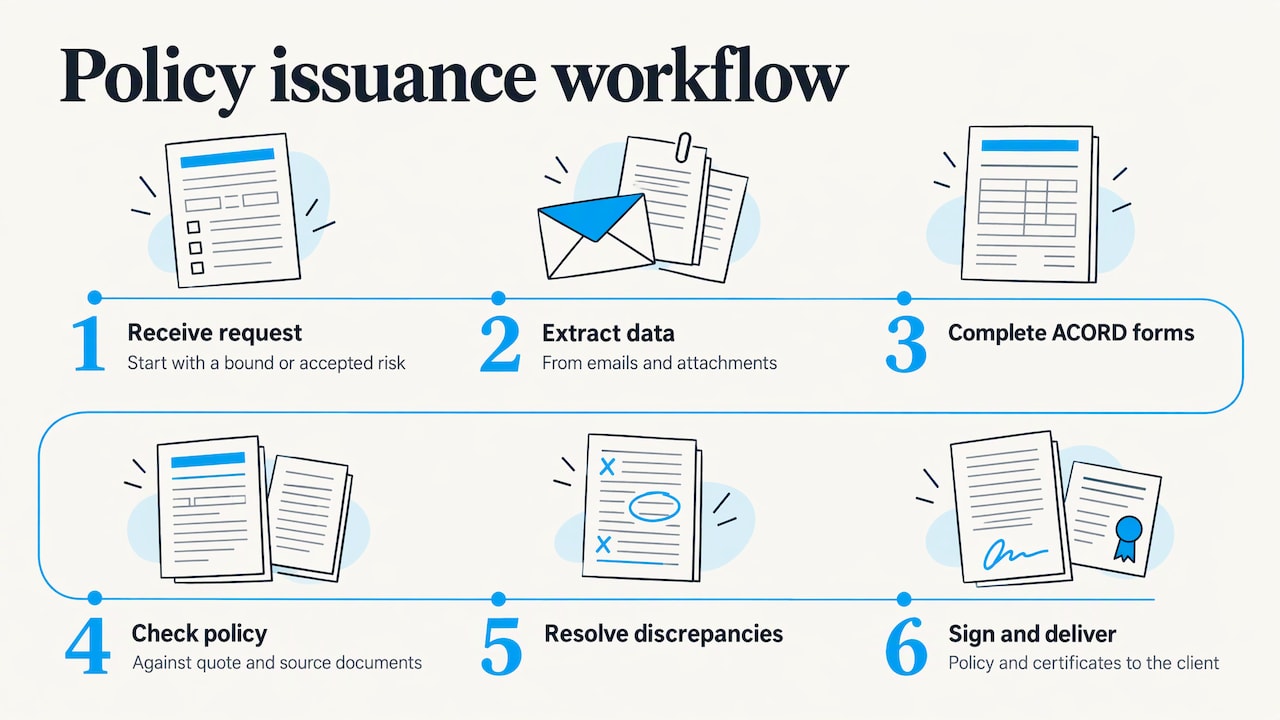
Automation does not replace that chain. It removes the retyping, the searching through inboxes and the visual comparison of documents that consume most of the time, and it flags what needs a person’s attention. Insurance policy issuance software is the category of tools that does this, from carrier-side electronic application platforms to workflow tools that sit alongside an agency management system.
An IDC study of 11 senior executives at Canadian life insurers and MGAs describes the fully electronic process as electronic illustration entry, application entry directly into carrier systems, electronic signatures, automated underwriting, near-time data transfer between carrier and MGA back-office systems, and electronic policy issuance and delivery. The study found the full benefit appears only when those elements work together. Automating a single step while the rest stays on paper moves the bottleneck rather than removing it.
Teams often blame underwriting turnaround. The Canadian evidence points to the quality of what arrives.
Manulife analyzed its 2013 life and critical illness cases and found that almost 61% of paper applications had unanswered questions. That produced 8,757 contract amendments, about 15% of contracts issued, and 29,600 requests for information. Missing information delayed a case by an average of four calendar days. In more recent advisor guidance, Manulife says the NIGO rate for new business applications is still close to 30%, and higher for policy change applications.
NIGO means “not in good order”: an application or request that cannot be processed because something is missing, unsigned or inconsistent. Every NIGO file triggers a request for information, a wait for the client’s reply and a second pass through the same file. Those loops, not the underwriting itself, account for much of the elapsed time between submission and policy delivery.
The same pattern appears in property and casualty work. IBAC’s 2023 study of live broker transactions found that slightly more than one-third of quotes differed by more than 2% from the carrier portal premium. A quote that differs from the final premium means a policy document that does not match what the client expected, and a correction before or after issuance.
The usual causes are easy to list:
Start where an error costs the most and where the work is most repetitive. For most agencies, MGAs and brokers the order below holds.
Issuance requests arrive as emails with attachments. Automated triage classifies each request, extracts the key details and assigns it, so nothing waits in a shared inbox. Inbox IQ is the Acord AI product for email automation and triage, handling incoming requests and routing them into the workflow.
Errors that enter at this stage are copied into every later document. Validate names, addresses, limits, vehicle or property details and effective dates against source documents before anything is prepared. Our guide on how to validate insurance policy data before you quote or bind sets out the checks in detail.
ACORD forms repeat the same data across several fields and pages. Pre-filling them from validated data removes the retyping and the transcription errors that follow. Forms IQ prepares ACORD forms within the Acord AI platform, with a person reviewing the output.
Before a policy is released, someone has to confirm it matches the quote, the binder and the client’s requested coverage. Done by eye, this is slow and uneven. Policy IQ handles AI policy checking and comparison and identifies exceptions for a reviewer, which is the step that most directly prevents errors from reaching the client.
Electronic signature and delivery close the loop. Blue Cross Quebec’s 2024 advisor guide states that e-signatures through Dropbox Sign have been accepted since February 12, 2023, while medical information transfer authorizations still require an original signature less than 90 days old. The lesson is general: each carrier and product has its own signature rules, so the workflow must know which document needs which kind of signature.
Certificate requests follow issuance and arrive in volume. Cert IQ handles certificate request handling inside the same platform, so certificates are produced from the issued policy rather than rebuilt by hand.
Agree on baselines before you start, then track the same measures afterward. The sources below give reference points for what Canadian organizations have measured.
| Measure | Reference point | Source |
|---|---|---|
| Average issuance time | 30+ days reduced to about 10 days with a comprehensive eApp process | IDC study, 2014 |
| NIGO submission rate | Up to 65% reduced to under 10% | IDC study, 2014 |
| Delay from missing information | Four calendar days on average per affected case | Manulife, 2013 cases |
| Quote effort, personal auto | 11% to 17% saved with quote APIs; duration cut by up to half | IBAC, 2023 |
| Policy change effort | 40% to 55% saved, duration cut 40% to 50%, with policy change APIs | IBAC, 2023 |
These are published results from specific studies, mostly on life insurance applications and on broker transactions, and your own figures will depend on your lines of business. The practical measures to track internally are:
Blue Cross Quebec’s guide also shows how carriers set cycle targets: policy entry within four business days of receiving documents, initial risk analysis within three business days, contract issuance within four business days of risk-selection acceptance, and quality control and shipping within two business days of issuance. Stage-by-stage targets like these make it clear where automation will take effect.
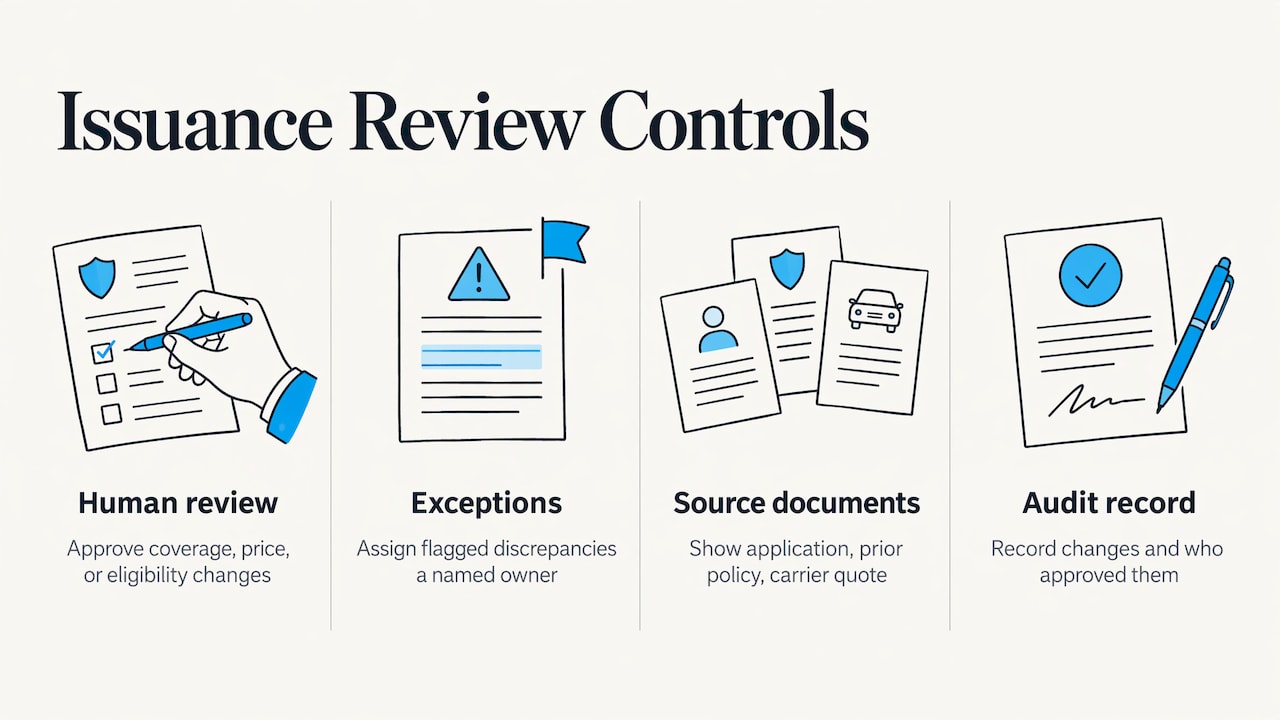
Automated issuance is only as reliable as its controls. Four belong in every design.
A review point at every decision. Automation should extract, compare and flag. A person should approve anything that changes coverage, price or eligibility. Acord AI pairs automation with human review for exactly this reason.
Exception handling with a clear owner. A flagged discrepancy needs a named person and a status, not a note in an inbox.
Source documents behind every field. A reviewer should be able to see where a value came from: the application, the prior policy, the carrier quote.
A record of what changed and who approved it. This supports internal quality control and regulator inquiries.
For carriers, the regulatory expectation on underwriting points the same way. FSRA states that underwriting decisions, whether automated or manual, must be based solely on filed underwriting rules, and that rejected applicants must receive written notice citing the specific underwriting reasons. A workflow that records the rule applied and the person who approved it makes that straightforward to show. Data quality is also a supervisory topic: CCIR’s 2021 market conduct report notes that data quality continues to be an issue for some respondents.
A tool that cannot read from and write to your agency management system, carrier portals and policy administration platform creates a new manual step. IBAC’s 2023 study found that policy change and quote APIs reduce broker effort and improve the customer experience, and that up to one-third of the effort and duration of measured transactions could have been offered to clients as self-service. IBAC encourages brokers to use the transactions their vendor and carrier partners have already implemented.
When you evaluate any issuance platform, list the systems it must connect to and the transactions you want automated, then confirm each connection with the vendor. Acord AI integrates with key industry systems, and our guide to insurance API integration for Canadian brokers and carriers explains the options.
Canadian organizations should work through five questions before committing.
Issuance errors are rarely a speed problem. They are a consistency problem: the same data entered several times, compared by eye, across documents that were never meant to be read side by side.
That is why we built Acord AI around the whole workflow rather than a single task. Inbox IQ brings requests in, Forms IQ prepares ACORD forms, Policy IQ checks and compares policies, Quotes IQ supports quoting and remarketing, Cert IQ handles certificate requests and Ask AIVA answers insurance questions. Each connects to the next, so data validated once stays validated.
We keep a person in the loop on purpose. Automation identifies exceptions and prepares the work; your team makes the call. That gives agencies, MGAs, brokers and carriers the reduction in manual workload and error rates without handing decisions to software.
the author
Acord AI is a subscription platform for agencies, MGAs, brokers and carriers, with automated email and request management, ACORD form preparation, policy checking and comparison, certificate handling and quoting support, all with human review. Pricing is not published; access begins with a demo. You can review the full set of products on the Acord AI solutions page or start at acordai.ai.
It is the use of software to handle the repetitive steps between an accepted application and a delivered policy: data extraction, form preparation, validation, policy checking, exception routing and delivery. People still review and approve decisions. The goal is fewer errors and shorter elapsed time.
It validates data against source documents before forms are prepared, so errors are caught at entry rather than copied into later documents. It also compares the issued policy with the quote and flags differences for a reviewer. Manulife’s data shows how costly the alternative is: almost 61% of the paper applications it analyzed had unanswered questions.
Target the correction loops first. Missing information delayed Manulife cases by four calendar days on average, so catching gaps at intake removes more time than speeding up later steps. Then automate form preparation and policy checking, and add electronic signature and delivery.
At minimum, your agency or broker management system, the carrier portals or APIs you use, your document storage and your email. IBAC’s 2023 study shows the value of connecting quote and policy change transactions directly rather than rekeying data.


One Platform. Smarter Insurance Operations. Start Your Journey Today.