How to Handle COI Requests Faster Without Losing Accuracy

Insurance coverage analysis is the structured review of what a policy actually covers (perils, limits, deductibles, exclusions and endorsements) measured against the exposures of the insured. Done consistently, it separates a policy that merely exists from one that responds to the loss it was bought for. Done by hand across a full book, it is slow and easy to get wrong. That is why agencies, MGAs, brokers and carriers are moving the document-heavy parts to policy checking and comparison with Policy IQ, where the software extracts and compares terms and people keep the decisions.
This guide sets out what the analysis examines, how it differs from underwriting and needs analysis, a repeatable process, and where automation fits without removing professional judgment.
A policy is a legally binding contract. The Insurance Bureau of Canada (IBC) describes it as setting out what is covered, the terms and conditions, the limits and the exclusions, and it encourages readers to review what is and is not included. Coverage analysis is that review, carried out by a professional and recorded.
The core items are:
Three activities are often mixed up because they use the same vocabulary.
Underwriting is the insurer’s side. The Financial Services Regulatory Authority of Ontario (FSRA) defines it as the process of assessing the amount of risk a potential or existing policyholder presents to an insurer. Underwriting rules are the criteria an insurer uses to decline, limit or terminate coverage, and in Ontario they must be filed with and approved by FSRA under section 238 of the Insurance Act. Underwriting asks whether and on what terms the insurer will take the risk.
Needs analysis starts with the client. The Financial Consumer Agency of Canada explains that insurance needs change with life events such as buying a home, starting a business, buying a car or taking a loan, and describes a policy as a contract that specifies which risks are covered, when the insurer pays and how much. In Quebec, the AMF requires representatives to assess client needs before an insurance contract is made. For insurance of persons, the analysis considers existing contracts, objectives, risk tolerance and financial knowledge, and is recorded in a dated document given to the client on or before policy delivery.
Coverage analysis sits between the two. It takes a policy that exists, or a quote that has been received, and tests it against the exposures the needs discussion identified. It is the step that confirms the product delivered is the product the client needed.
| Activity | Whose question | Starting point | Output |
|---|---|---|---|
| Underwriting | The insurer’s | Applicant’s risk profile | Accept, decline or limit, with a price |
| Needs analysis | The client’s | Life or business circumstances | Documented needs and objectives |
| Coverage analysis | The advisor’s | Policy or quote and the exposures | Gaps, errors and recommendations |
Consistency matters more than sophistication. A team that follows the same sequence on every file produces comparable results, and that makes review and audit possible.
Collect the application, the prior policy, the quote or binder, the issued policy with all forms and endorsements, and any schedules. Analysis based on a summary page misses the form language where exclusions live. Errors at this stage carry through every later step, which is why the validation of policy data before quoting or binding deserves its own routine. Our guide on validating insurance policy data covers it in detail.
List what the insured owns, does and owes: buildings, contents, equipment, operations, vehicles, contractual obligations, liabilities to third parties. For commercial clients, include the exposures that changed since last year, such as a new location, new services, higher revenue or a new lease with insurance requirements. The Financial Consumer Agency of Canada notes that premiums depend on factors including the value of goods insured, the amount of coverage needed, the deductible and claim history, and these are the same facts the analysis must reconcile.
IBC distinguishes named-perils property coverage, which covers the listed perils subject to exclusions, from all-risk coverage, which covers perils unless they are specifically excluded, as described on its page about types of business coverage. The difference decides where the burden sits when a loss is unusual. On a named-perils form, a peril that is not listed is not covered. On an all-risk form, the exclusions section does the real work and must be read line by line.
IBC advises that evaluating business policy limits should take into account rebuilding and replacement values, potential liability exposures, past losses and any coinsurance conditions. In practice that means asking four questions for each coverage line:
Property valuation is rarely a desk exercise alone. The physical condition of a site, including its security arrangements, changes the exposure being insured, and a practical resource such as commercial property security planning in BC helps frame what an assessor will look for on a commercial site.
Read each exclusion against the exposure map. The question is never whether an exclusion exists, since every policy has them, but whether an excluded risk is one this insured actually faces. Then compare endorsements to the instructions on file: an endorsement requested at renewal but missing from the issued policy is a common source of disputes. The policy checking and comparison review process describes how to document discrepancies between source documents and the issued policy so that they can be corrected before the insured relies on them.
Write down what was reviewed, what was found, what was recommended and what the insured decided. A dated record protects the insured and the firm, and it is the same discipline the AMF expects in needs analysis for insurance of persons. Where a gap is accepted, the file should show that it was explained.
Gaps are coverage the insured assumes they have and do not. Overlaps are duplicate coverages that raise cost without raising protection. Misfit limits are limits that exist but are too low, too high or structured badly for the exposure.
The quickest method is a side-by-side grid: exposures down the left, coverages across the top, and in each cell the limit, the deductible and any exclusion that touches that exposure. Blank cells are gaps. Cells with two entries are potential overlaps. Cells where the limit is far from the replacement or liability figure are misfits.
When the same comparison is needed across several carriers, the grid becomes a quote comparison. Putting the terms next to each other, rather than comparing premiums alone, is the point of bringing the terms of competing quotes into view.
Not every file needs the same depth of review at the same moment. The Chambre de l’assurance de dommages (ChAD) recommends sorting files by criteria such as premium size or the presence of specific or excluded risks, and it specifically suggests prioritizing policies that exclude sewer-backup coverage. That guidance comes from Quebec, but the logic applies in any province: spend the most time where the exposure and the consequences are largest.
A workable triage rule has three tiers:
The exposures behind a tier-one flag are often physical. A commercial building with sprinklers, standpipes and hydrants raises different questions than one without, and a reference such as a guide to fire protection systems shows the equipment an assessor may need to identify when confirming that protective-device conditions are met.
ChAD encourages updating personal-lines files every three years and commercial-lines files annually, as set out in its renewal obligations guidance. It also notes that starting renewal work 60 to 90 days ahead can allow the insured to receive renewal terms 30 days before expiry. The source presents this as a recommendation, and automobile renewal notice requirements are handled separately, so check the rules that apply in your province.
At renewal, the sequence is to verify the insured’s needs, review the coverage in force and advise the insured, then check the issued renewal for errors and for consistency with the requested changes. The last check is the one most often skipped, and it is the one a systematic comparison catches.
Where more than one person is named on a policy, ChAD’s guidance on co-insureds adds that representatives should obtain information from named insureds to identify needs and describe the proposed product and nature of coverage before contracting. Build that into the information-gathering step.
The analytical judgment is the valuable part of the job. The slow part is everything around it: finding the right document in an inbox, reading forms of different layouts, re-keying values into an agency system, and following up on quotes that were entered incorrectly.
The Insurance Brokers Association of Canada (IBAC) and Online Business Systems measured broker transactions over three weeks in 2022. They found that quote APIs reduced broker effort by 11 to 17 percent through less double entry and fewer follow-ups on incorrect quotes, and that policy-change APIs could reduce broker effort by 40 to 55 percent and shorten the duration of a policy change by 40 to 50 percent. The Centre for Study of Insurance Operations (CSIO) describes the underlying problem: without real-time policy-data exchange, brokers must work through different insurer processes, portals or phone calls, and its API standards aim to reduce manual entry and portal reliance. IBAC’s technology site adds that standardized data exchange can provide real-time accurate policy information and reduce turnaround time and costs.
For carriers, the same direction is visible in underwriting. FSRA’s report observes that with automation, applications are completed and uploaded electronically and the risk is evaluated against embedded underwriting rules, and that insurers are legally required to adhere strictly to their approved rules once filed. Rules applied by a system must be the rules on file, which is a reminder that automation needs governance and review.
Integration is covered in more detail in our guide to insurance API integration for Canadian brokers and carriers.
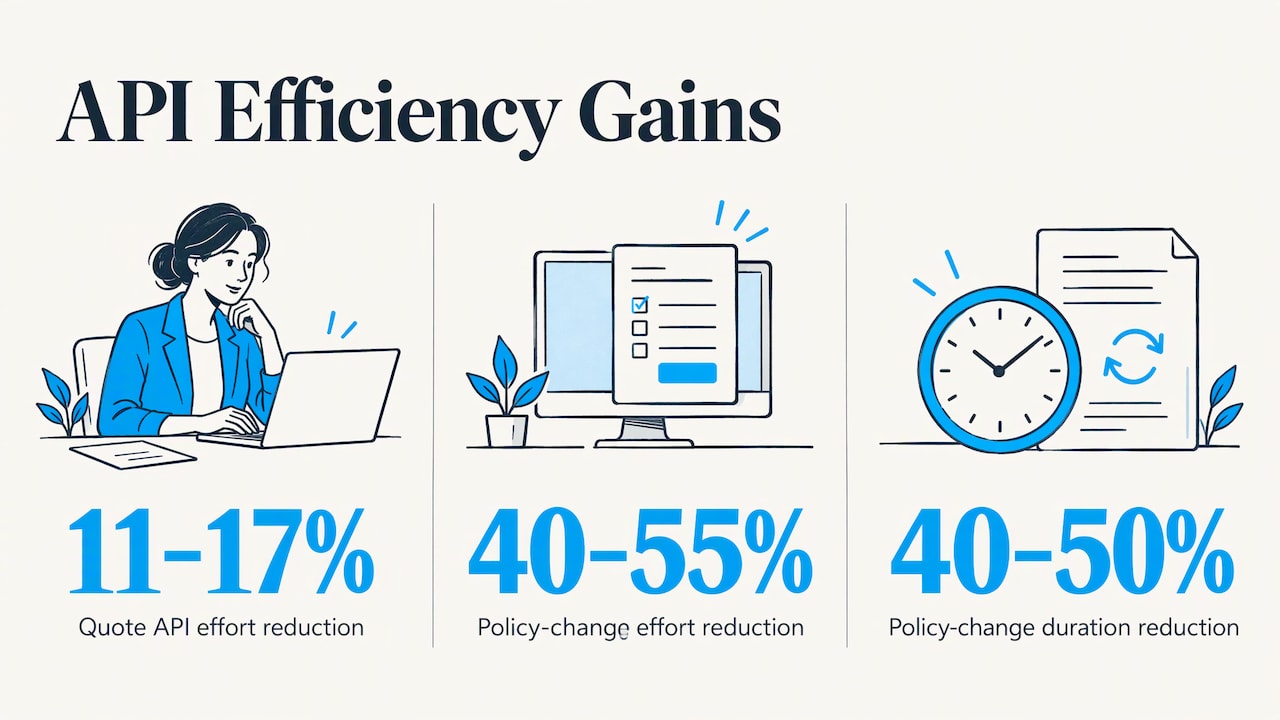
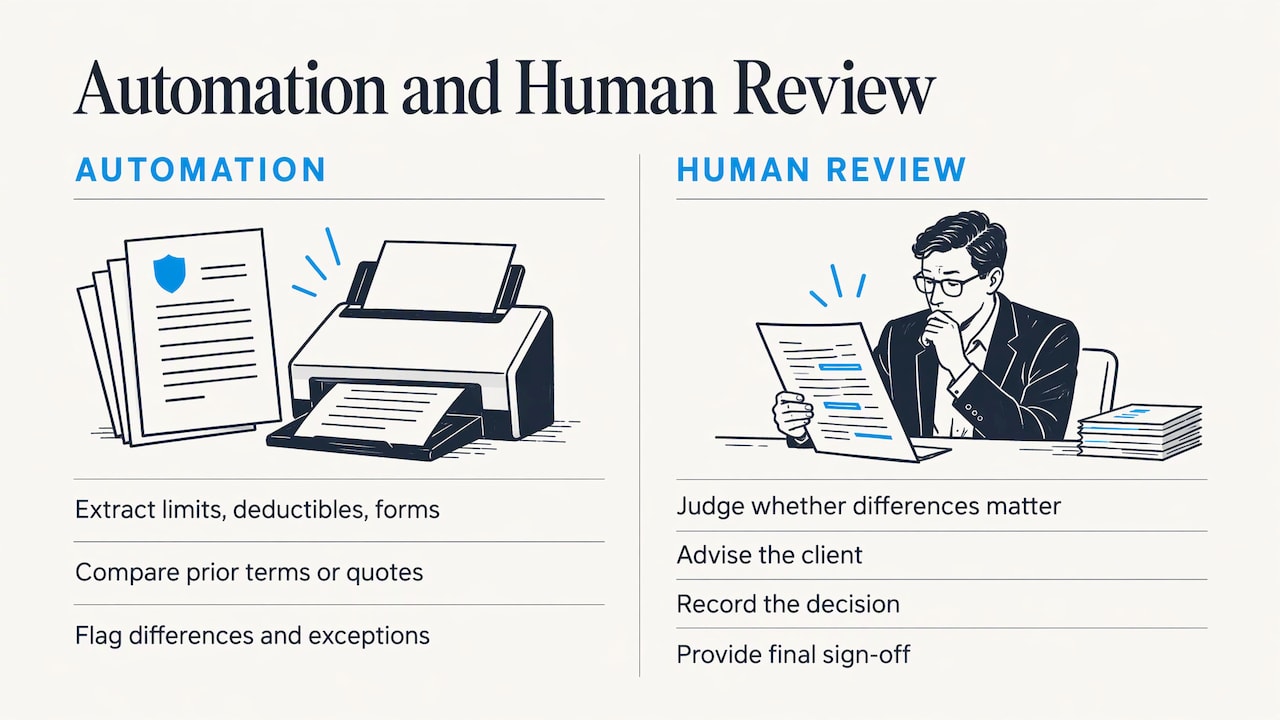
The tasks that automate well are the mechanical ones: extracting limits, deductibles, forms and endorsements from documents, placing them in a standard structure, comparing them to the prior term or to another quote, and flagging differences. The tasks that stay with people are the interpretive ones: deciding whether a difference matters for this insured, advising the client and recording the decision.
Acord AI is built around that division. Policy IQ handles policy checking and comparison, document analysis and exception identification, workflows can be configured to the way a team works, and human review stays in place for decision-making. Other modules cover related steps that feed the analysis: Inbox IQ for email and request management, Forms IQ for ACORD form preparation, Quotes IQ for quoting and remarketing support, Cert IQ for certificate requests and Ask AIVA as an insurance knowledge assistant. They are listed on the all solutions page.
A sensible rollout starts with one repeatable review, such as renewal checking on commercial accounts, defines what counts as an exception, and keeps the reviewer’s sign-off as the final step.
Some searches for coverage analysis are really about analytics. Insurance data analytics, as NFP describes it, turns relevant data into representative and meaningful distributions that give organizations insight into risk, which can inform negotiations with markets and the structure of risk management programs. Carriers use similar methods in pricing: HIROC’s underwriting analytics role involves predictive modeling and rate review supported by dashboards and data pipelines. That work informs how risk is priced and structured, whereas coverage analysis reviews the contract of one insured. The two meet when claim and loss data from the first sharpen the limits and conditions tested in the second.
Coverage analysis fails less often from lack of expertise than from lack of time. A reviewer who has to find the documents, read three different form layouts and re-key figures has little attention left for the question that matters: does this policy respond to this insured’s loss?
Our view is that the extraction and comparison should be automated and the judgment should not. Acord AI combines intelligent automation with configurable workflows and human oversight, so discrepancies, exceptions and differences between source documents and the issued policy surface early, and a licensed professional decides what to do about them.
We also believe the review should connect to the rest of the workflow. A finding that sits in a separate tool does not help the person preparing the form, answering the certificate request or remarketing the account. That is why our modules work together and integrate with key industry systems, so that the analysis, the quote and the paperwork share the same data.
the author
Teams that want the checking, comparison and exception-flagging steps of coverage analysis handled in one place can see how Acord AI fits their agency, MGA, brokerage or carrier operation.
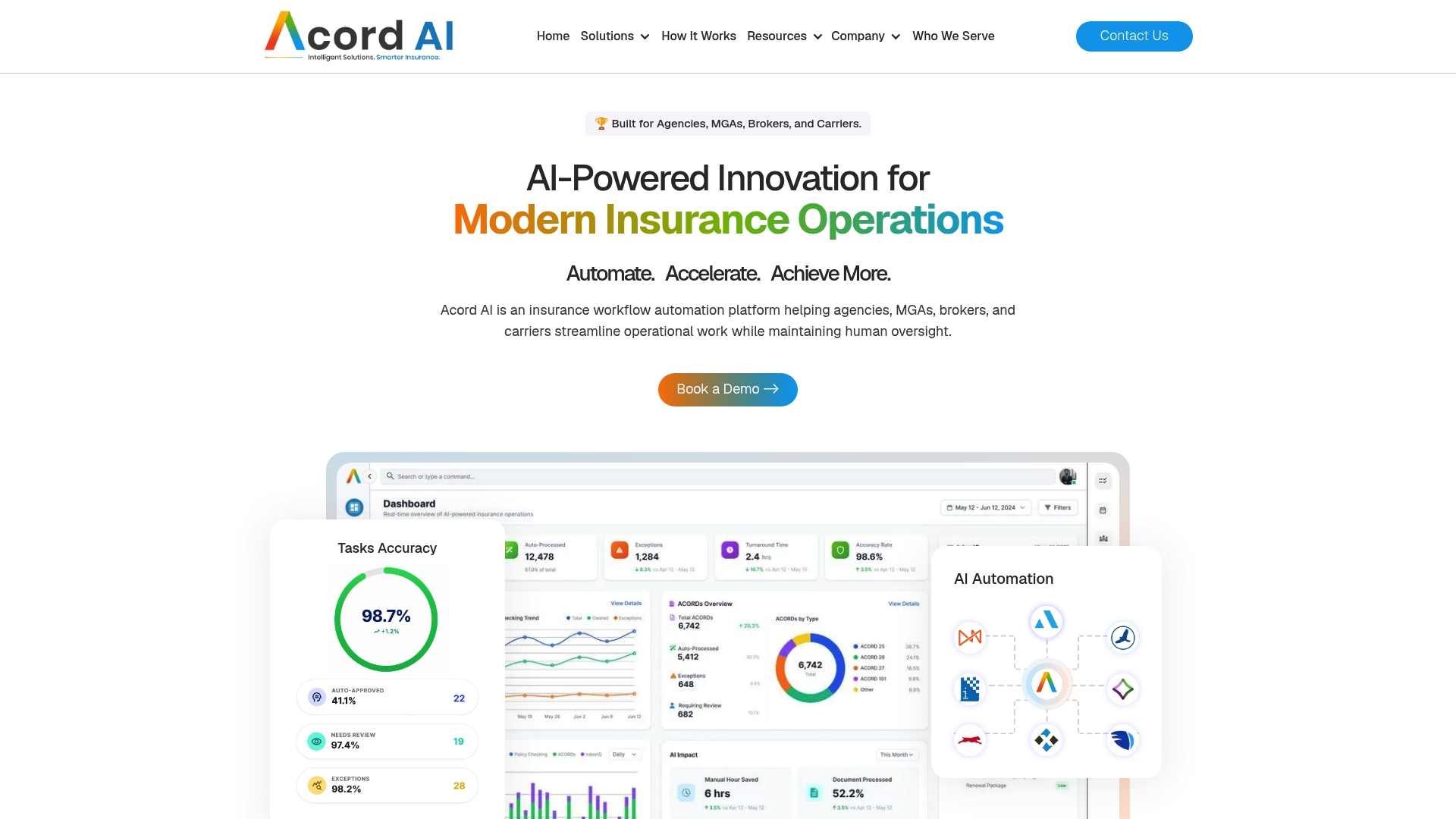
Policy IQ is the module for policy checking and comparison, and the full set of modules is on the solutions overview. The Policy IQ workflow guide walks through how the review runs, and the Who We Serve page shows how each type of organization uses the platform.
Levels usually refer to limits: the overall maximum a policy pays, and sublimits for specific coverages within it. IBC defines a policy limit as the maximum an insurer will pay overall or for a particular coverage. Higher limits cost more, so the right level depends on rebuilding or replacement values, liability exposure and loss history.
It is the documented assessment of what an insured needs to protect, based on their circumstances and objectives. In Quebec the AMF requires representatives to assess needs before an insurance contract is made and to record the analysis in a dated document for the client. Coverage analysis then checks that the policy matches those needs.
Insurers assess the likelihood and cost of an insured event using the information on the application and their underwriting rules. The Financial Consumer Agency of Canada lists factors such as age, claim history, value of goods insured and deductible. In Ontario, rules that decline, limit or terminate coverage must be filed with and approved by FSRA.
ChAD encourages updating commercial-lines files annually and personal-lines files every three years, and suggests starting renewal work 60 to 90 days before expiry. A change in the insured’s exposures, such as a new location or a major purchase, justifies a review sooner.
Software can extract terms from documents, compare them with the prior term or other quotes and flag exceptions. The professional still decides what the findings mean for the insured and advises them. Acord AI is designed with human review in that decision step.


One Platform. Smarter Insurance Operations. Start Your Journey Today.