How to Handle COI Requests Faster Without Losing Accuracy
MGA workflow automation works best when it takes over the repetitive handling of documents and data, such as reading submissions, checking policies, preparing ACORD forms and assembling quotes, and leaves the underwriting and advice decisions with people. Acord AI is built on that division: its platform automates email and request management, policy checking, ACORD form preparation, certificate requests and quoting support, with human review for decision-making. This guide sets out which MGA operations are worth automating first, how they connect to broker and carrier systems, and how to measure the result.
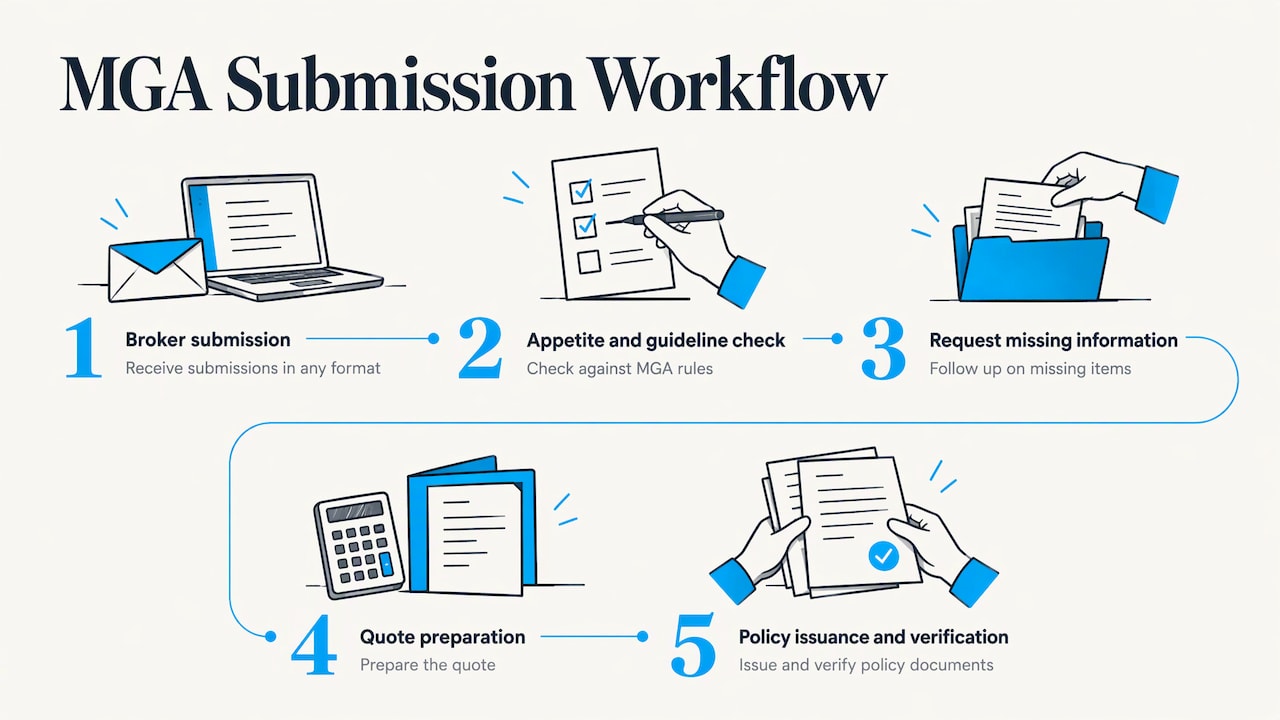
An MGA (managing general agent) is an intermediary that holds delegated authority from carriers to underwrite and place business. That position puts a heavy load of document handling in the middle: brokers send submissions in whatever format they have, the MGA checks them against appetite and guidelines, requests what is missing, prepares the quote and then issues and verifies the policy documents.
Most of that work is repetitive and rule-based, but it is also detailed. A missed endorsement, a mismatched limit or a transposed address creates a discrepancy that surfaces later as an error, an E&O exposure or a frustrated broker. That combination of volume and precision is why workflow automation, with a person reviewing the output, suits MGAs and the agencies, brokers and carriers they work with.
The State of InsurTech Report, published by the Insurance Council of British Columbia in June 2024, gives a Canadian picture of where automation already sits. It found that 81% of the industry automated aspects of quote calculation and 17% automated information intake. In other words, the calculation step is largely handled, while the work of getting information into the system in the first place still depends on manual effort at most organizations.
For an MGA, that points to a practical sequence:
| Workflow | What the manual version looks like | What automation takes on |
|---|---|---|
| Email and request intake | Shared inboxes, forwarding, retyping details | Sorting and routing incoming requests, extracting the details |
| Submission handling | Reading PDFs and spreadsheets, spotting gaps | Document analysis and identifying missing items |
| Policy checking | Line-by-line comparison against quotes or expiring terms | Comparing documents and flagging exceptions |
| ACORD forms | Re-keying the same data into several forms | Preparing forms from the information already captured |
| Certificate requests | Individual requests handled one at a time | Structured handling of certificate requests |
| Quoting and remarketing | Assembling terms from several carriers | Supporting quote preparation and comparison |
Each of these has a counterpart in the Acord AI product line: Inbox IQ for email and request management, Policy IQ for policy checking and comparison, Forms IQ for ACORD forms, Cert IQ for certificate requests, Quotes IQ for quoting and remarketing support, and Ask AIVA, an insurance knowledge assistant. You can see how they fit together on the Acord AI solutions page.
Intake is where files stall. A broker sends a submission with a loss run attached as a scan, a driver list in a spreadsheet and the application in the body of an email. Someone has to read all of it, decide what is absent and write back.
Automating this step means three things happen before an underwriter opens the file:
The third point is where time is usually lost. Each round trip with a broker adds a day or more to the file, and each partial request invites another. Acord AI’s Inbox IQ addresses this stage with automated email and request management, and its guide to application processing walks through where time disappears between receipt and quote.
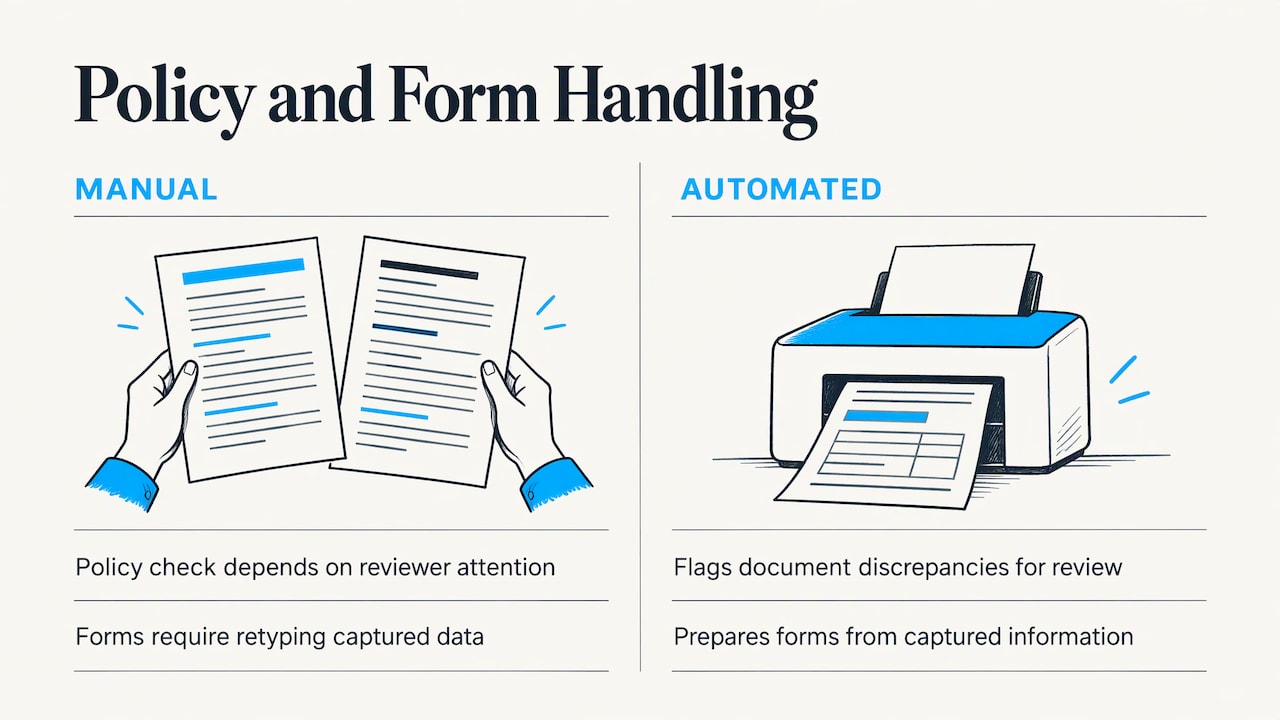
Policy checking compares what was quoted or requested against what was issued: limits, deductibles, endorsements, named insureds, effective dates. Done by hand, it is slow and depends on the reviewer’s attention at the end of a long day. Done with automated document analysis, discrepancies between source documents are surfaced as exceptions for a person to resolve. Policy IQ is the Acord AI product for this, covering policy checking and comparison.
The principle behind a good check is the same whether or not software is involved: validate the data before you quote or bind, not after. Our guide on validating insurance policy data before you quote or bind sets out which fields to confirm and where errors typically enter.
ACORD forms follow the same logic. The data on an application, a certificate request or a supplemental form is largely the data already captured at intake. Preparing the forms from that captured information, instead of retyping it, removes a duplicate step and a duplicate source of error. Forms IQ is the Acord AI tool for ACORD form preparation.
Quote work has two parts: gathering inputs and comparing outputs. Calculation is the part the Canadian industry has already automated most widely. What remains is assembling clean inputs and presenting the resulting terms in a way a broker or client can compare without opening five PDFs.
Automation helps here by carrying validated submission data into the quote, supporting remarketing when a renewal needs to go back to market, and laying out coverage terms side by side. Quotes IQ supports quoting and remarketing, and the guides on insurance quote automation for Canadian agencies and bringing quote terms into view cover the mechanics in more depth.
Automation that sits outside your systems of record creates a new copy-and-paste step. The value comes when data moves between systems without being retyped.
The Insurance Brokers Association of Canada (IBAC) tested this directly. Its February 2023 connectivity study describes APIs (application programming interfaces, the connections that let two systems exchange data automatically) transmitting data in real time between broker and carrier systems. That removes double entry, which the study says introduces delays and data-quality issues. The reported results:
These figures come from personal-lines testing between brokers and carriers, so treat them as evidence of what removing double entry can do rather than a forecast for a specific commercial book. The direction is what matters for an MGA: every system boundary where a person rekeys data is a place to lose time and accuracy.
Acord AI integrates with industry systems, and its guide to insurance API integration for Canadian brokers and carriers explains what to ask of any integration before it goes live: which systems, which data fields, and which direction the data flows.
Automation should not make the decisions that carry regulatory, financial or relationship weight. The Canadian data shows the industry already draws the line there. In the same InsurTech report, 64% of surveyed organizations had humans review underwriting decisions, 83% had sales professionals ask the quoting questions and 96% had a sales professional speak with consumers before binding.
A workable division for an MGA:
This is the design Acord AI follows: the platform prepares and checks, and its human review step keeps decision-making with your team. Exceptions are identified so reviewers spend their time on the files that need judgment instead of rereading files that do not.
The regulatory backdrop is moving toward closer attention to how MGAs operate. Ontario’s regulator, FSRA, stated in its FY2024-2025 Statement of Priorities that it is strengthening the MGA regulatory framework for life and health insurance, including consultation on a proposed MGA Rule and supporting guidance. Whatever your line of business, consistent, documented handling of files is easier to demonstrate when the workflow is structured.
A sensible implementation sequence:
The IBAC study is also a useful template for measurement. It tracked quote duration, accuracy and time taken to quote, along with broker work and client wait time for policy changes. An MGA can use the same categories:
| Measure | How to capture it |
|---|---|
| Submission-to-quote turnaround | Timestamp at receipt and at quote release, by line of business |
| Touches per file | Count of manual handoffs and rekeying steps |
| Error and discrepancy rate | Exceptions found at policy checking and corrections after issuance |
| Follow-up rounds with brokers | Number of requests for missing information per submission |
| Broker wait time | Time from broker request to response on changes and certificates |
Record a baseline for a few weeks before you change anything. Compare the same measures after rollout, by workflow, so you can see which step produced which gain.
Acord AI is an insurance workflow automation platform for agencies, MGAs, brokers and carriers. It covers the stages described above: Inbox IQ for email and requests, Policy IQ for policy checking and comparison, Forms IQ for ACORD forms, Cert IQ for certificate requests, Quotes IQ for quoting and remarketing, and Ask AIVA as an insurance knowledge assistant. Workflows are configurable, the platform integrates with industry systems, and human review stays in the loop. The company has been recognized as an Inc. 5000 Honoree for growth.
If your team handles submissions, policy checks and quotes by hand today, the Acord AI solutions overview shows each product and the workflow guides behind it, and a demo is the route to platform access.
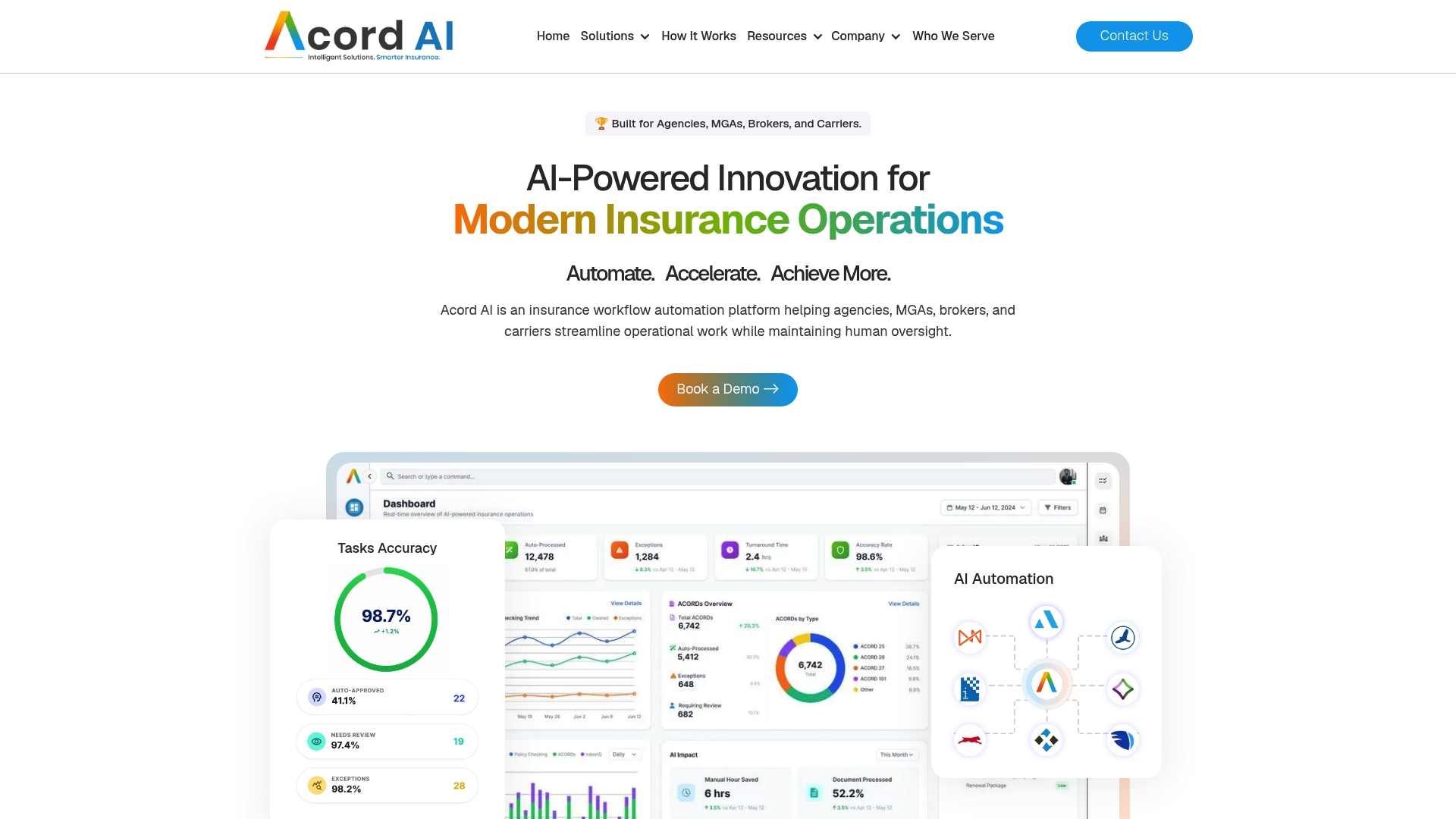
MGAs do not lose time because their people lack skill. They lose it because skilled people spend hours reading attachments, retyping data and comparing documents line by line.
We built Acord AI around that observation. Automation should take the repetitive handling, and people should keep the judgment. That is why every workflow in our platform keeps human review in place for decision-making, and why we configure workflows to the way an agency or MGA already operates.
The strongest results come from connecting the steps. Intake that feeds policy checking, checking that feeds forms, and forms that feed quotes remove the rekeying between them. That is the difference between a tool that helps with one task and a workflow that shortens the file.
the author
It is the use of software to handle repeatable operational steps in an MGA’s file lifecycle, such as email triage, submission intake, policy checking, ACORD form preparation and quote preparation. Underwriters and reviewers still make the decisions. The software prepares the information and flags exceptions.
Start with the step that repeats on every file and causes the most waiting, which is usually intake or policy checking. Canadian survey data shows quote calculation is already widely automated while information intake is not, so intake often has the most room to improve.
No. In the Insurance Council of British Columbia’s 2024 survey, 64% of organizations had humans review underwriting decisions. Acord AI is designed with human review for decision-making, so underwriters spend their time on judgment and on the exceptions the platform identifies.
Compare a baseline with post-rollout figures for quote turnaround, touches per file, error rates and broker wait time. IBAC’s connectivity study used similar measures, including quote duration, accuracy and client wait time for policy changes.


One Platform. Smarter Insurance Operations. Start Your Journey Today.